

Few questions reveal a richer crossover than understanding what does cultural artifact mean in fashion, especially when you realize a car interior can carry as much cultural weight as a hand-stitched garment. When AMC bolted rivets into seat upholstery and stitched contrast thread through vinyl to mimic blue denim, they weren’t just decorating a car. They were encoding American workwear identity into sheet metal and foam. That single design decision turned a compact car into a wearable statement. This guide unpacks what cultural artifacts mean in fashion, why it matters to car culture, and how you can engage with both worlds respectfully.
Table of Contents
- Understanding cultural artifacts in fashion: definitions and heritage
- How fashion communicates culture through artifacts and practices
- Cultural appropriation vs. appreciation in fashion design
- Automotive fashion as cultural artifact: examples and semiotics
- Respectful incorporation of cultural artifacts in automotive fashion
- Why automotive fashion’s cultural artifacts matter more than you think
- Explore apparel inspired by automotive cultural artifacts at All Motor
- Frequently asked questions
Key Takeaways
| Point | Details |
|---|---|
| Cultural artifact definition | In fashion, artifacts are garments or designs that carry cultural meaning and heritage from their creators and communities. |
| Fashion as cultural archive | Fashion preserves and transmits identity, social status, and traditional craftsmanship beyond mere aesthetics. |
| Respect matters | Distinguishing cultural appreciation from appropriation requires understanding meaning, crediting sources, and avoiding trivialization. |
| Automotive fashion examples | Cars like AMC’s Levi’s Edition show how auto design can serve as cultural artifacts reflecting fashion and community identity. |
| Ethical design guidelines | Respectful incorporation involves collaboration, acknowledging origins, and honoring intangible cultural heritage linked to garments. |
Understanding cultural artifacts in fashion: definitions and heritage
The term “cultural artifact” gets used loosely, but it has a precise meaning worth anchoring to. A cultural artifact is anything created by humans that conveys information about the culture and values of its creators and users, covering both ancient objects and thoroughly modern ones. That includes a Navajo blanket, a leather racing jacket, and yes, a limited-edition car interior stitched to look like denim.
In fashion specifically, cultural artifacts operate on two levels:
- Tangible artifacts: Physical garments, accessories, and materials that carry visible cultural codes, like embroidery patterns, dye techniques, or construction methods passed down through generations.
- Intangible heritage: The knowledge, rituals, and social meanings attached to those garments, including when they are worn, by whom, and what they signal about status or identity.
UNESCO treats cultural heritage as both tangible objects and intangible traditions passed through generations, explicitly including fashion garments and the practices surrounding them. That framework matters because it stops us from treating a garment as just cloth and thread. It forces us to ask what knowledge lives inside it.
“Fashion is not merely decoration. It is a record of who made it, why, and what they believed about the world.”
Understanding this definition of cultural artifacts reframes how we look at automotive design. A car’s visual language, its color choices, material selections, and surface details, can function as a cultural artifact in exactly the same way a garment does.
How fashion communicates culture through artifacts and practices
Fashion has always done more than cover the body. It archives. Fashion acts like cultural archives where textile knowledge and body adornment encode social meaning across generations. The importance of fashion in culture lies precisely in this archival function. What you wear communicates affiliation, belief, and history without a single spoken word.
Consider how this plays out across cultures:
- Status signaling: In many West African traditions, specific woven patterns in kente cloth indicate royal lineage. The pattern is not decorative. It is a title.
- Ritual function: Japanese kimono construction follows rules that encode seasonal meaning, social occasion, and regional identity simultaneously.
- Community recognition: Motorcycle club patches operate on the same logic. The iconography is a coded language readable only within the community.
- Ceremonial communication: Body adornment in the Solomon Islands conveys social status and supports ceremonial communication with ancestors, making ornament inseparable from spiritual practice.
The cultural significance in fashion runs deeper than aesthetics. UNESCO formally recognizes traditional craftsmanship and the objects it produces as intangible cultural heritage, meaning the skill of making a garment carries as much weight as the garment itself.
- What are fashion artifacts? They are garments or accessories that carry encoded cultural knowledge, whether a ceremonial headdress or a hand-stitched racing suit.
- Cultural expression through clothing is how communities preserve identity across time, particularly when written records are scarce or absent.
“When a community loses its traditional dress, it often loses the vocabulary to describe itself to the world.”
This is why the definition of cultural artifacts matters beyond academic interest. It changes how we evaluate design choices, including those made by automotive engineers and stylists.
Cultural appropriation vs. appreciation in fashion design
This is where understanding gets uncomfortable. Not all borrowing is equal. Appropriation involves unacknowledged or disrespectful use of cultural elements, often stripping sacred symbols of meaning, while appreciation involves research, respect, and credit to the source community.
The distinction matters because fashion has a long history of extracting visual elements from marginalized cultures and selling them back as trend pieces, with none of the profit or recognition returning to the origin community.
Signs of appropriation:
- Using sacred or ceremonial symbols as accessories without understanding their meaning
- Profiting commercially from cultural elements while the source community faces discrimination for the same practices
- Presenting borrowed elements as “exotic” or “inspired by” without naming the culture directly
- Reducing complex traditions to a single aesthetic detail
Signs of appreciation:
- Crediting the specific culture and artisans involved in the design
- Collaborating directly with community members rather than copying from a distance
- Researching the social context of a garment before incorporating its visual language
- Sharing economic benefit with the source community
Pro Tip: Before you buy or wear a garment that draws from a specific cultural tradition, spend five minutes researching whether the brand collaborated with or compensated artisans from that tradition. It takes almost no time and changes the meaning of what you wear.
How does fashion reflect culture responsibly? It starts with that research. The same standard applies to automotive fashion design, where visual codes borrowed from workwear, racing history, or regional craft traditions carry real cultural weight.
Automotive fashion as cultural artifact: examples and semiotics
This is where car culture and fashion theory meet in the most concrete way. Automotive design has always borrowed from fashion, and the best examples function as genuine cultural artifacts in their own right.

AMC’s 1973 Gremlin Levi’s Edition used contrast stitching, copper rivets, and branded hardware to transform the car’s interior into a direct reference to American workwear culture. The denim visual language was not incidental. It was a deliberate sign system, turning the cabin into a wearable statement about blue-collar American identity. That car is now a cultural artifact in two registers: automotive history and fashion history simultaneously.
| Design element | Fashion parallel | Cultural meaning |
|---|---|---|
| Contrast stitching on seats | Denim seam detail | American workwear heritage |
| Copper rivets on upholstery | Levi’s rivet reinforcement | Industrial labor culture |
| Branded badging on interior | Logo placement on garments | Brand as cultural identity |
| Color-matched exterior/interior | Coordinated outfit styling | Intentional self-presentation |
Repeated visual motifs in automotive design function like traditional garment patterns. They create community recognition. A car enthusiast who spots an RB26-specific hood bulge reads it the way a textile expert reads a regional weave pattern. It signals origin, capability, and belonging.
- Automotive fashion design that references specific engineering heritage carries this same semiotic weight.
- Car-inspired apparel built around iconic engines like the LS7 encodes community identity the same way a club patch does.
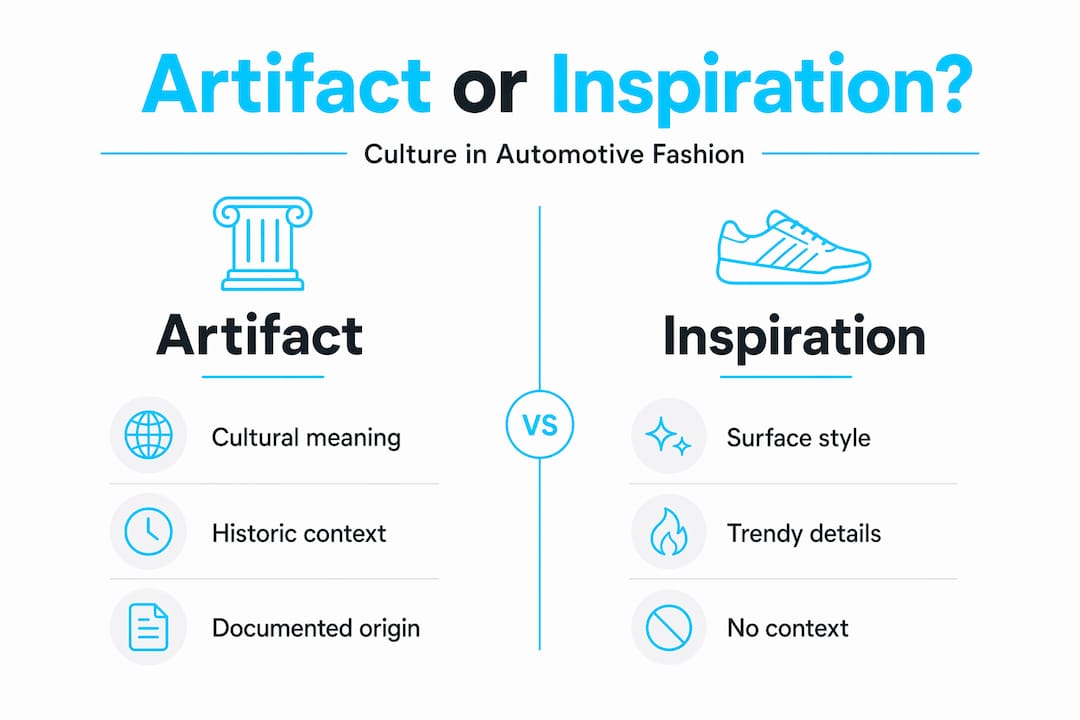
- Fashion inspired by car culture works best when it draws on specific, documented engineering traditions rather than generic “racing” aesthetics.
Pro Tip: When evaluating automotive fashion, ask whether the design references a specific cultural or engineering tradition. Generic racing stripes are decoration. A hand-drawn illustration of an RB26 DETT with accurate detail is a cultural artifact.
Respectful incorporation of cultural artifacts in automotive fashion
Knowing the theory is one thing. Applying it in practice is another. Whether you are a designer or a consumer, these principles keep engagement with cultural artifacts honest.
- Identify the source. Know exactly which culture, tradition, or community the design element comes from. “Japanese-inspired” is not specific enough. “Referencing the bosozoku custom car tradition of 1970s Japan” is.
- Check for collaboration. Did the brand work with people from that tradition? Did artisans or community members contribute to the design? If yes, that is a meaningful signal of respect.
- Avoid sacred or ceremonial symbols. Some symbols are not available for fashion use regardless of how well-intentioned the designer is. Sacred geometry, ceremonial insignia, and ritual objects belong to their communities.
- Anchor in living traditions. UNESCO’s intangible cultural heritage framework connects garments to living craftsmanship, not just historical aesthetics. Design that honors a living tradition carries more integrity than one that treats culture as a historical prop.
- Credit openly. Labeling a garment as “denim-inspired” without naming Levi Strauss & Co. or American workwear history flattens the meaning. Naming the source deepens it.
Ethical automotive fashion requires acknowledging origin, avoiding costume trivialization, and demonstrating genuine research or collaboration to preserve meaning. That standard is not difficult to meet. It just requires intention.
Pro Tip: Look for brands that name their references specifically. “Inspired by the 2JZ-GTE engine used in the 1993 Toyota Supra” is a statement of cultural respect. “JDM vibes” is not.
Why automotive fashion’s cultural artifacts matter more than you think
Here is the perspective most articles skip entirely. Automotive fashion is not a niche crossover topic. It is one of the most widely distributed forms of cultural expression in the modern world, and almost nobody treats it with the analytical seriousness it deserves.
A racing jacket worn by a Le Mans driver in 1966 carries the same archival function as a ceremonial garment from any other tradition. It encodes the values of a specific community at a specific moment: precision engineering, physical courage, national competition, and the aesthetics of speed. When that jacket gets reproduced as a fashion item without any of that context, something real is lost.
The same is true for engine-specific apparel. When a garment references an LS7 or a 2JZ, it is not just a picture of a motor. It is a claim about identity, community, and engineering values. The automotive cultural storytelling embedded in those references deserves the same respect we would give any other form of cultural expression through clothing.
Ignoring cultural meaning in automotive fashion does not just produce bland design. It actively flattens histories that took decades to build. The tuner culture that developed around the 2JZ engine in Japan is a genuine subculture with its own rituals, aesthetics, and values. Wearing a garment that references it without understanding it is the same category of error as wearing a traditional garment from any other culture without knowing what it means.
The enthusiasts who get this right are the ones who know their references. They wear the history, not just the aesthetic.
Explore apparel inspired by automotive cultural artifacts at All Motor
Understanding what cultural artifacts mean in fashion changes how you choose what to wear. It raises the standard. And that is exactly the standard All Motor builds to.

Every piece in the All Motor apparel collection is built around specific, documented engineering heritage. The LS7 Foundation Series Hoodie carries hand-drawn illustrations of one of the most celebrated American V8 engines ever produced. The 2JZ Engine Hoodie honors a Japanese engineering tradition that defined a generation of performance culture. These are not generic “car guy” graphics. They are cultural artifacts in garment form, built with the specificity and respect the tradition deserves. Limited drops mean each piece stays rare and intentional.
Frequently asked questions
What exactly is a cultural artifact in fashion?
A cultural artifact in fashion is a garment or accessory that carries cultural information about the traditions, values, and social context of its creators and users, including both its physical design and the meanings attached to it.
How does cultural appropriation differ from appreciation in fashion?
Appropriation takes cultural elements without understanding or credit, often stripping sacred symbols of meaning for commercial gain, while appreciation involves genuine research, collaboration, and acknowledgment of the source culture.
Can cars be considered cultural artifacts in fashion?
Yes. Cars with deliberate fashion references, like AMC’s Levi’s Edition with its denim-coded interior, function as cultural artifacts by encoding social identity and cultural meaning through design.
What should designers consider to respect cultural artifacts in fashion?
Designers should acknowledge origin and meaning, avoid trivializing sacred symbols, and demonstrate research or direct collaboration with the source community to preserve the integrity of cultural heritage.
0 comments